The Norwegian fjords


+ 3
When people think of Norway, many of them picture the fjords.
The Norwegian fjords are long, narrow arms of the sea carved by glaciers and surrounded by steep mountains. The most famous fjords are the UNESCO-listed Geirangerfjord and Nærøyfjord, in Western Norway between Stavanger and Ålesund.
With more than 1700 fjords in Norway, it can be hard to know where to start. We've helped travelers explore the fjords since 1982. In this guide, we at Fjord Tours share what we've learned: which fjords to visit, the best ways to experience them, and when to go.
Scroll to:
Discover our favorite fjords
Already know which fjord you want to know more about? Explore our in-depth guides for each fjord.

The Geirangerfjord
The Geirangerfjord is one of Norway's most visited tourist sites and has been included on the UNESCO World Heritage List, along with the Nærøyfjord, since 2005.

The Nærøyfjord
Surrounded by towering mountains up to 1,700 metres high, this arm of the Sognefjord is amazingly beautiful.

The Sognefjord
Norway’s longest fjord, the Sognefjord, is located in the heart of Norwegian fjord country and extends more than 200 km (120 miles) inland.

The Aurlandsfjord
Together with the Nærøyfjord, the Aurlandsfjord is one of the most picturesque fjords in the world.

The Hardangerfjord
If the Sognefjord is the King of the fjords of Western Norway, the Hardangerfjord is the Queen.

The Lysefjord
The Lysefjord is the southernmost of the biggest fjords in Norway. The 40-kilometre-long fjord is flanked by steep mountains, some more than 1,000 meters.

The Nordfjord
The Nordfjord is the sixth longest fjord in Norway, spanning a distance of 105 kilometres (66 mi). It is 565 meters (1,854 ft) deep.

The Hjørundfjord
Discover the spectacular Hjørundfjord on an authentic Norwegian fjord cruise from Ålesund, where dramatic Sunnmøre Alps meet pristine waters away from tourist crowds.
The Geirangerfjord
The Geirangerfjord is one of Norway's most visited tourist sites and has been included on the UNESCO World Heritage List, along with the Nærøyfjord, since 2005.
The Nærøyfjord
Surrounded by towering mountains up to 1,700 metres high, this arm of the Sognefjord is amazingly beautiful.
The Sognefjord
Norway’s longest fjord, the Sognefjord, is located in the heart of Norwegian fjord country and extends more than 200 km (120 miles) inland.
The Aurlandsfjord
Together with the Nærøyfjord, the Aurlandsfjord is one of the most picturesque fjords in the world.
The Hardangerfjord
If the Sognefjord is the King of the fjords of Western Norway, the Hardangerfjord is the Queen.
The Lysefjord
The Lysefjord is the southernmost of the biggest fjords in Norway. The 40-kilometre-long fjord is flanked by steep mountains, some more than 1,000 meters.
The Nordfjord
The Nordfjord is the sixth longest fjord in Norway, spanning a distance of 105 kilometres (66 mi). It is 565 meters (1,854 ft) deep.
The Hjørundfjord
Discover the spectacular Hjørundfjord on an authentic Norwegian fjord cruise from Ålesund, where dramatic Sunnmøre Alps meet pristine waters away from tourist crowds.
Summary
Norwegian fjords in short
Norway’s best-known fjords are in Western Norway, between Stavanger and Ålesund. For a first trip, we recommend the Nærøyfjord or the Geirangerfjord.
The easiest way to experience the fjords without a car is by combining a fjord cruise with scenic trains, buses, and overnight stays. May to September gives you the widest choice of cruises, hikes, and activities.

What are the Norwegian fjords?
The Norwegian fjords are deep, narrow inlets where the sea reaches far inland between steep mountains. They formed over many ice ages, as huge glaciers slowly carved deep valleys into the rock. When the ice melted, the sea filled the valleys.
Today, Norway's fjords are known for their high mountain walls, powerful waterfalls, and small villages by the water. The Geirangerfjord and Nærøyfjord are on the UNESCO World Heritage List as the West Norwegian Fjords. UNESCO added them in 2005 as some of the world's best examples of fjord landscapes.
The fjords have also shaped life in Norway. For centuries, the water was the easiest way to travel between farms and villages, because the mountains made land travel hard. Many small communities still live close to the water, and some farms can only be reached by boat or on foot.
Where are the fjords in Norway?
You'll find most of the famous fjords in Western Norway, between Stavanger, Bergen, and Ålesund. This region is often called Fjord Norway. There are also fjords along the rest of the coast, from the Oslofjord in the south to Finnmark in the far north.
The easiest way to choose a fjord is to start with the city you're traveling from:
- From Bergen: Sognefjord, Nærøyfjord, Aurlandsfjord, and Hardangerfjord
- From Ålesund: Geirangerfjord, Hjørundfjord, and Nordfjord
- From Åndalsnes and Molde: Romsdalsfjord
- From Stavanger: Lysefjord
- In Northern Norway: Trollfjord, between Lofoten and Vesterålen
- From Oslo: Oslofjord. It's wider and calmer than the fjords in Western Norway, without the steep mountains, but it's still well worth a trip. From the water, you'll see the Oslo Opera House and the small islands around the city.

The 10 fjords we recommend visiting
Each fjord in Norway is unique. Some are famous for waterfalls; others for viewpoints, hikes, or quiet villages. Here are the 10 fjords we know best, and why we recommend them.
Geirangerfjord
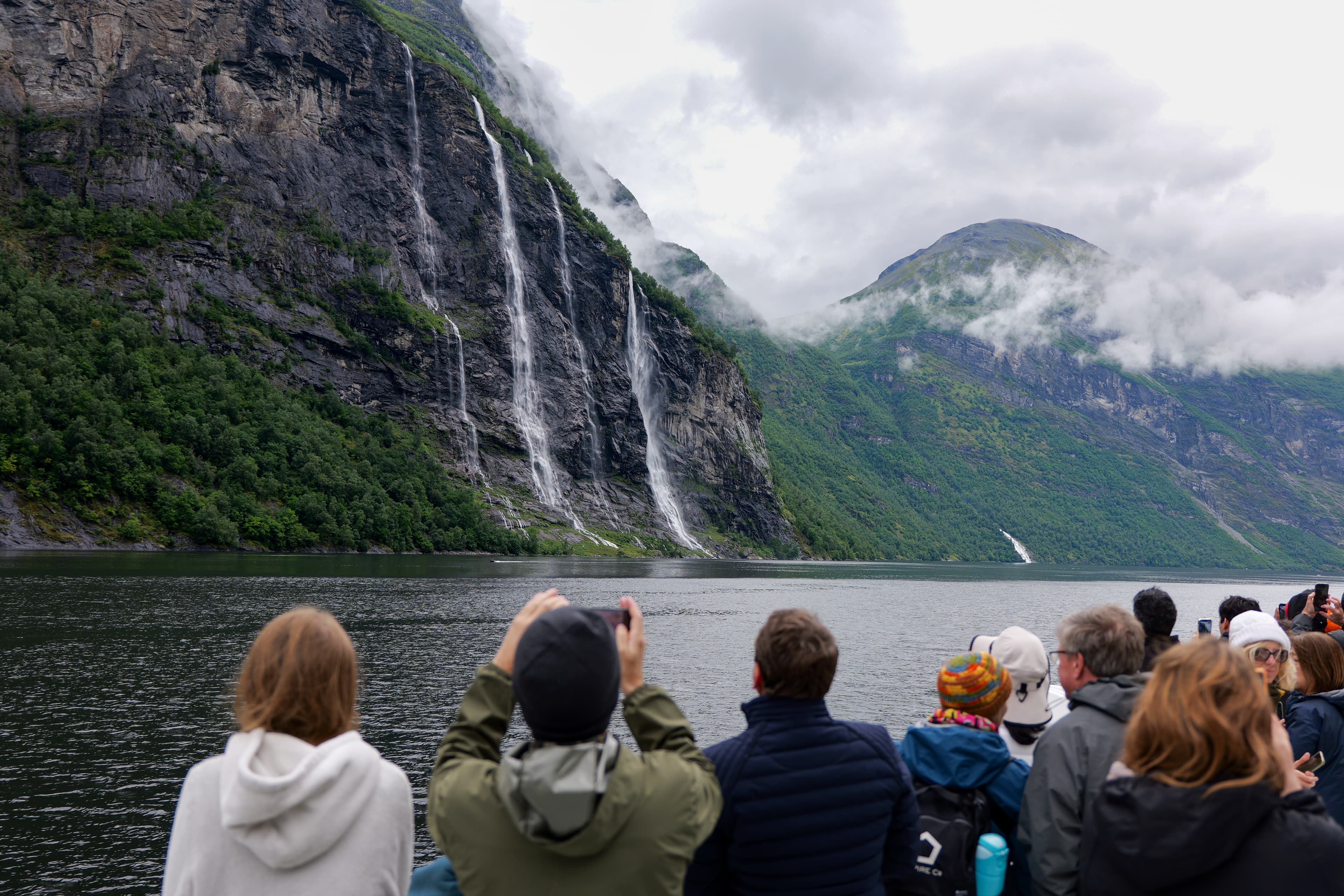
The Geirangerfjord is a UNESCO World Heritage Site and one of Norway's best-known fjords. From a boat, you'll see the Seven Sisters and the Suitor waterfalls, and old mountain farms high above the water. From viewpoints like Flydalsjuvet and Dalsnibba, you can look down on the fjord.
Read more about the Geirangerfjord
Sognefjord
The Sognefjord is Norway's longest and deepest fjord, often called the "King of the fjords." It stretches 205 km inland and is more than 1300 meters deep. Along its many arms, you'll find fjord villages, stave churches, glaciers, and the famous Nærøyfjord and Aurlandsfjord.
Read more about the Sognefjord
Nærøyfjord
The Nærøyfjord is one of the world's narrowest fjords, only about 250 meters wide at its narrowest point. Together with the Geirangerfjord, it's a UNESCO World Heritage Site. We recommend a fjord cruise on the Nærøyfjord between Flåm and Gudvangen to see the steep mountains and waterfalls from the water. This cruise is part of the Norway in a Nutshell® tour.
Read more about the Nærøyfjord
Aurlandsfjord
The Aurlandsfjord is an arm of the Sognefjord and home to the village of Flåm. From here, you can ride the Flåm Railway, cruise to the Nærøyfjord, and visit the Stegastein viewpoint, 650 meters above the fjord.
Read more about the Aurlandsfjord
Hardangerfjord
The Hardangerfjord is Norway's second-longest fjord. It's known for its fruit farms, which bloom with white and pink flowers in May. You can also walk behind the Steinsdalsfossen waterfall, visit Vøringsfossen waterfall, see the Folgefonna glacier, or hike to Trolltunga.
Read more about the Hardangerfjord
Lysefjord
The Lysefjord near Stavanger is 42 km long, with rock walls that rise almost straight up from the water. It's home to 2 of Norway's most famous hikes: Preikestolen (Pulpit Rock) and Kjerag.
Read more about the Lysefjord
Nordfjord
The Nordfjord lies between Bergen and Ålesund, near Jostedalsbreen, the largest glacier in mainland Europe. We recommend taking the Loen Skylift up Mount Hoven for views across the Nordfjord, or visiting the Briksdal Glacier to explore the glacier landscape.
Read more about the Nordfjord
Hjørundfjord
The sharp peaks of the Sunnmøre Alps surround the Hjørundfjord near Ålesund. It's quieter than many of the better-known fjords, with historic hotels and mountain hikes. Choose it if you want fjord views with fewer people around.
Read more about the Hjørundfjord
Romsdalsfjord
The Romsdalsfjord leads to Åndalsnes, a small town surrounded by high mountains. Nearby, you'll find the Romsdalen valley, the Troll Wall, and the Trollstigen mountain road. You can also get here by train on the Rauma Railway, and the Atlantic Road is within driving distance.
Read more about the Romsdalsfjord
Trollfjord
The Trollfjord is in Northern Norway, between Lofoten and Vesterålen. It's only about 2 km long, with a narrow entrance and steep mountains on both sides. On a boat trip, you may see sea eagles flying overhead.
Read more about the Trollfjord

How to experience the fjords
We recommend seeing the Norwegian fjords both from the water and from a viewpoint above. Here are our favorite ways to explore and how to choose the best way for you.
Fjord cruises
A fjord cruise lets you experience the fjord from the water, with views of steep mountains, waterfalls, and villages along the shore. Many fjord villages and farms are hard to see from the road, but you'll pass right by them on the water. Most fjord cruises in Norway are day trips of 1 to 3 hours. Our favorite fjord cruises are:
- The electric fjord cruise on the Nærøyfjord, between Flåm and Gudvangen
- A cruise on the Geirangerfjord to see the Seven Sisters waterfall
- A cruise on the full length of the Sognefjord, passing fjord villages and varied landscapes on your way
Train and fjord tours
If you're looking for a seamless way to travel by train and fjord cruise, join one of our self-guided tours. We plan all your transport for you.
- Norway in a Nutshell® from Oslo or Bergen, with the Flåm Railway and a cruise on the Nærøyfjord
- Sognefjord in a Nutshell™ from Bergen, with a cruise on the Sognefjord and the Aurlandsfjord, and the Flåm Railway
- Geirangerfjord in a Nutshell™ to Geiranger, with train, mountain bus, and a cruise on the Geirangerfjord
- Hardangerfjord in a Nutshell™ from Bergen, through the Hardangerfjord, with a photo stop at the Vøringsfossen waterfall
- Preikestolen & Norway in a Nutshell® from Oslo or Bergen, with a hike overlooking the Lysefjord
Hiking and viewpoints
We believe that seeing the fjords from above is a highlight. It's the view many people picture when they think of Norway, and it feels very different from seeing the fjord from the water.
On a fjord cruise, you're close to the cliffs and waterfalls, looking up at the mountains. From a viewpoint, you see the whole picture: how the fjord lies between the mountains, and how small the villages and boats look far below. We recommend seeing the fjord from both ways to feel how big the landscape really is.
Some viewpoints, like Stegastein above the Aurlandsfjord, are easy to reach by car or bus. Others, like Preikestolen above the Lysefjord, are a half-day hike.
Our tip: Visit Stegastein early in the morning or in the evening, when the light is softer, and there are fewer people.
Kayaking
To see the fjords up close and in a peaceful yet active way, join a kayaking tour. You paddle slowly past waterfalls and feel small on the big fjords.
Often, the only sound is your paddle in the water.
We especially like kayaking from May to September, when most guided trips run, and when the weather is milder.
Scenic drives
The roads along the fjords are just as pretty. Many fjord roads are part of the Norwegian Scenic Routes, such as Trollstigen. These roads are often narrow and winding, with car ferries along the way. Prefer not to drive? Join a bus tour and enjoy the views while someone else drives.
Which option suits you?
- You want to travel by train and boat, without planning the connections: Choose a package tour like Norway in a Nutshell®. We plan the timing for you, so you can relax and enjoy the views while still traveling on your own.
- You want the freedom to drive: Rent a car and set your own pace. In winter, check which mountain roads are open before you go.
Discover the fjords with Fjord Tours
These fjord itineraries take you to the best fjords using scenic trains, fjord cruises, and bus rides, all in one seamless trip.


Flexible itinerary
With Norway in a Nutshell®
Fjords, coast & mountains
Geirangerfjord and Norway in a Nutshell®
-
Geirangerfjord plus Norway’s most famous scenic route, Trollstigen
-
From 3 days · Add extra nights
-
Start in Oslo or Bergen
-
Available June – September
From 9672 NOK


Flexible itinerary
With Norway in a Nutshell®
Cultural cities & scenic trains
Cities and Coastal Cruise
-
Oslo, Bergen and Trondheim, linked by scenic trains and a coastal voyage
-
From 4 days · Add extra nights
-
Start in Oslo or Bergen · Round trip
-
Available year-round
From 11931 NOK


Fully planned
Slow down on the shores of Sognefjord
Sognefjord Cruise & Balestrand Stay
-
Fjord cruise, glacier tour & 2 nights in Balestrand
-
3 days · Fixed itinerary
-
Start in Oslo or Bergen
-
Available May – September
From 9477 NOK


Fully planned
With Norway in a Nutshell®
Timed for winter daylight
Winter Fjords & Flåm from Oslo
-
Ride the Bergen Railway across snowy mountains, with 1 night in Flåm
-
Hotel, selected meals, transport & Stegastein included
-
2 days · Fixed itinerary
-
Start in Oslo or Bergen · One-way trip
-
Available November – March
From 5626 NOK


Fully planned
Fjords, glaciers & coast
Norway’s Great Fjords
-
Discover 3 fjords, glaciers, mountains & a coastal voyage
-
Hotels, transport, and activities included
-
8 days · Fixed itinerary
-
Start in Oslo · Round trip
-
Available June – September
From 28950 NOK
Flexible itinerary
With Norway in a Nutshell®
Fjords, coast & mountains
Geirangerfjord and Norway in a Nutshell®
-
Geirangerfjord plus Norway’s most famous scenic route, Trollstigen
-
From 3 days · Add extra nights
-
Start in Oslo or Bergen
-
Available June – September
From 9672 NOK
Flexible itinerary
With Norway in a Nutshell®
Cultural cities & scenic trains
Cities and Coastal Cruise
-
Oslo, Bergen and Trondheim, linked by scenic trains and a coastal voyage
-
From 4 days · Add extra nights
-
Start in Oslo or Bergen · Round trip
-
Available year-round
From 11931 NOK
Fully planned
Slow down on the shores of Sognefjord
Sognefjord Cruise & Balestrand Stay
-
Fjord cruise, glacier tour & 2 nights in Balestrand
-
3 days · Fixed itinerary
-
Start in Oslo or Bergen
-
Available May – September
From 9477 NOK
Fully planned
With Norway in a Nutshell®
Timed for winter daylight
Winter Fjords & Flåm from Oslo
-
Ride the Bergen Railway across snowy mountains, with 1 night in Flåm
-
Hotel, selected meals, transport & Stegastein included
-
2 days · Fixed itinerary
-
Start in Oslo or Bergen · One-way trip
-
Available November – March
From 5626 NOK
Fully planned
Fjords, glaciers & coast
Norway’s Great Fjords
-
Discover 3 fjords, glaciers, mountains & a coastal voyage
-
Hotels, transport, and activities included
-
8 days · Fixed itinerary
-
Start in Oslo · Round trip
-
Available June – September
From 28950 NOK

Famous fjord attractions
Some places are worth planning your trip around. These 3 attractions are among our favorites.
- Stegastein viewpoint: A viewing platform 650 meters above the Aurlandsfjord, a short drive or bus ride from Flåm.
- Seven Sisters waterfall: 7 streams of water falling side by side into the Geirangerfjord, best seen from a fjord cruise.
- Flydalsjuvet viewpoint: The classic view of Geiranger village and the fjord, about 40 min on foot from the village.
The best fjords in Norway
We believe that the best fjord in Norway is the Geirangerfjord or the Nærøyfjord. The best fjord for you, however, depends on what you want to see and do. For a first visit, we recommend the Nærøyfjord and Aurlandsfjord because you can reach them easily by train from both Oslo and Bergen.
- For your first fjord trip: Nærøyfjord and Aurlandsfjord
- For classic waterfalls and viewpoints: Geirangerfjord
- For combining hiking and a city break: Lysefjord
- For glaciers: Nordfjord
- For fewer crowds and cultural activities: Hjørundfjord or Hardangerfjord
- For Northern Norway: Trollfjord
When to visit the fjords
The best time to visit Norway’s fjords is May to September. The days are long, the weather is milder, and most cruises, hikes, and activities are available. You can visit the fjords all year, but it will give you a different experience, depending on when you’re there.
- Spring (April to May): Snow on the peaks and powerful waterfalls as the snow melts
- Summer (June to August): The mildest weather, the longest days, and the most activities
- Autumn (September to October): Fewer visitors and colorful leaves in the valleys
- Winter (November to March): Quiet fjords, snowy mountains, and year-round cruises on some fjords
Practical information about the fjords
A little planning makes your trip much easier. After more than 40 years of organizing fjord trips, these are the tips we share most often.
FAQ about the Norwegian fjords
Start planning your fjord trip
For a seamless way to see a fjord, ride a scenic train, and take a cruise in 1 trip, Norway in a Nutshell® is a great place to start.
- All connections planned for you
- See the best-known highlights