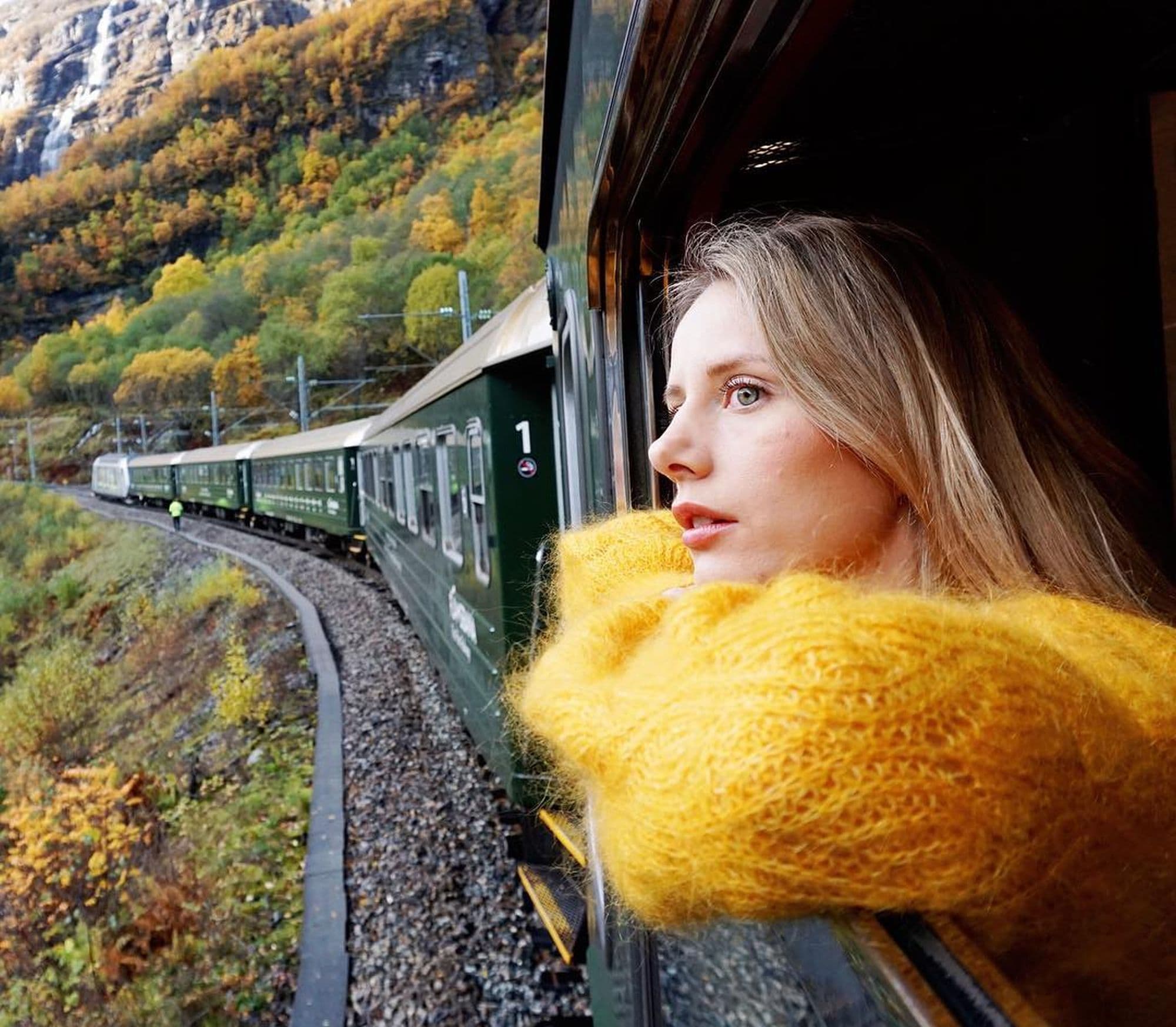
The Bergen Railway: Oslo to Bergen by train
The Bergen Railway (Bergensbanen) runs between Norway’s 2 largest cities, and for many people it’s the Norwegian train journey. In 7 hours, you go from the forests around Oslo up to the Hardangervidda mountain plateau and on to the West Coast and Bergen.
Written by
The Fjord Tours team
6 min readUpdated: Sep 11, 2026

The railway was one of Norway’s greatest engineering feats when it opened in 1909. The train passes as many as 180 tunnels over the course of the 471-kilometer journey, and meets the Flåm Railway at Myrdal.
In this guide, we share all the tips we gathered over 40+ years of operating on this railway. From journey highlights and departures to the best seats and where to break the trip if you want to stop along the way.
Quick facts
Bergen Railway at a glance
- Name: Bergen Railway (Bergensbanen in Norwegian)
- Route: Oslo to Bergen
- Distance: 471.25 km
- Journey time: 6.5–7.5 hours
- Highest point: Finse, over 1200 meters, the highest on the Norwegian network
- Crosses: The Hardangervidda, Northern Europe’s largest mountain plateau
- Change here: Myrdal, for the Flåm Railway
- Operator: Vy
- Opened: 1909
- Recognition: Named one of Europe's best train journeys by Lonely Planet
Source: Vy / Bane NOR.

Route and highlights
From Oslo, the train goes through green valleys and small station towns before it starts to climb. After a few hours, the trees thin out and you reach the Hardangervidda: an open, treeless plateau covered in snow. You can see one of Norway’s best-known glaciers, the Hardangerjøkulen, along the way.
Finse is the most famous stop on this stretch. At 1222 meters, it’s so high and bare that it doubled as the ice planet Hoth in The Empire Strikes Back. There is no road to Finse; you can only reach it by train or on foot.
After Finse, the line drops west, past Myrdal (where the Flåm Railway branches down to the fjord), then past Voss to Bergen. The scenery turns greener the closer you get to the coast.
That whole change from eastern forest, snow-covered plateau, western fjords, all in one ride is why the Bergen Railway is counted among the world’s great scenic railways.
To keep the line running through winter, long stretches are covered by snow enclosures that protect the track from snow; a detail that’s easy to miss from inside a warm carriage.

Where to stop along the way
Most travelers ride straight through, but the Bergen Railway is easy to break up. There are 4 stops that are especially worth it.
Myrdal
Change here for the Flåm Railway down to the fjord. You’ll see high mountains on the way in, fjords on the way down. Myrdal is one of the most popular stops on the Bergen Railway.
Finse
Stop in Finse for close-up mountain views. There are short hikes straight from the station in summer, and a real stillness, since the only way to get here is by train. In winter, Finse is a starting point for long ski trips across the plateau.
Geilo
Geilo is a well-known mountain resort with plenty to do outside the ski season, too: hiking, climbing and cycling in summer, and pools with slides for children.
Voss
Voss is a small town famous for skiing and extreme sports, and a natural last stop before Bergen. A cable car right by the station takes you straight up into the mountains for the view.

Which side should you sit on?
Which side you sit on matters less than you might think. The scenery changes the whole way, from forest to mountain and back, so both sides give good views on different parts of the route.
If you want to photograph the Finse section, watch both sides of the train windows. The train passes mountain lakes on one side and steep walls on the other. You’ll know when you’ve reached Finse when your eyes have to adjust to the bright white landscapes right as you exit a long tunnel.
Our real tip: visit the bistro car, with windows made for exactly this kind of ride.
Scenery with a cinnamon bun is hard to beat!

Traveling with family on the Bergen Railway
The Bergen Railway has family carriages with more room and a play area, which makes the long ride easier for small children. But for children, the ride is often as much the point as the fjord at the end. Many children find the shift from farmland to snow-covered mountains just as exciting as the fjord itself, and the bistro car is a good place to stretch legs on a long day.
Are you traveling on Norway in a Norway®? Read our guide on traveling with children.
Journey time and departures
The Bergen Railway runs several times a day each way, with day trains and one night train with sleeper cabins.
Day trains suit people who want to watch the scenery; the night train suits people who would rather sleep and arrive rested. Either way, the trip takes about the same, 6.5 to 7.5 hours, with some change by season and number of stops. Winter runs a little slower, since the train eases through the most exposed parts of the plateau.
There are more departures in summer than in midwinter, so check the current timetable close to your travel date, especially in spring and autumn.
The Bergen Railway has a bistro car for food and drink, space for luggage, and power sockets at most seats. The train has Wi-Fi, but it can drop out in the high mountains or in tunnels.

Bergen Railway tickets and prices
Most train tickets in Norway follow the same pricing: the cheapest tickets sell first, and prices go up as a departure fills. When you book Bergen Railway tickets, the earlier you book, the less you usually pay.
When you book train tickets from Oslo to Bergen, you can usually choose between standard class and a comfort class. Comfort class costs more, but you get a bigger seat, more legroom, free coffee and tea, and a quieter car.
If you're traveling on to the fjords, you can also book the whole route as 1 trip. On our tours, we plan all your tickets and connections, so you don't need to book each part yourself.
Oslo to Bergen: Train or plane?
Choosing between the train and plane from Oslo to Bergen depends on how much time you have, which is why we say the honest trade-off is time. The flight between Oslo and Bergen takes under an hour; the train takes over 6 hours. But what you get in return is non-stop views of the Norwegian countryside that you don’t get from the air.
Besides the views, you also avoid the stress of flying. The train skips the security queues, check-in, and trips to the airport, since both stations sit right in the city center.
Choosing the train over a plane is also a more sustainable option. The train runs on renewable electricity across the whole line, so it carries a far smaller footprint than flying. For most people who take the train, the day itself is part of the trip. To learn more about how we work with sustainable travel, read our commitment to sustainability.
Tours including the Bergen Railway
Travel between Oslo and Bergen by train and combine it with a boat ride through the fjords. See more of Norway - without a car.


2027 bookings open
The classic journey
Norway in a Nutshell®
-
See the highlights: UNESCO Nærøyfjord, Flåm and Bergen Railway
-
From 1 day
-
Available year-round
-
Start from Oslo or Bergen
From 2698 NOK


With Norway in a Nutshell®
2027 bookings open
Explore beyond the highlights
Geirangerfjord and Norway in a Nutshell®
-
See Norway's coast, famous fjords and scenic mountains
-
From 3 days
-
Available June – September
-
Start from Oslo or Bergen
From 9672 NOK


2027 bookings open
Slow and comfortable
Sognefjord in a Nutshell™
-
Explore Norway's longest fjord at a relaxed pace
-
From 1 day
-
Available April – October
-
Start from Oslo or Bergen
From 2745 NOK


2027 bookings open
Slow down on the shores of Sognefjord
Sognefjord Cruise & Balestrand Stay
-
Fjord cruise, glacier tour & 2 nights in Balestrand
-
3 days
-
Available May – September
-
Start from Oslo or Bergen
From 9477 NOK


With Norway in a Nutshell®
2027 bookings open
Cultural cities & scenic trains
Cities and Coastal Cruise
-
Trondheim, Oslo and Bergen round trip
-
From 4 days
-
Available year-round
-
Start from Oslo or Bergen
From 11931 NOK
2027 bookings open
The classic journey
Norway in a Nutshell®
-
See the highlights: UNESCO Nærøyfjord, Flåm and Bergen Railway
-
From 1 day
-
Available year-round
-
Start from Oslo or Bergen
From 2698 NOK
With Norway in a Nutshell®
2027 bookings open
Explore beyond the highlights
Geirangerfjord and Norway in a Nutshell®
-
See Norway's coast, famous fjords and scenic mountains
-
From 3 days
-
Available June – September
-
Start from Oslo or Bergen
From 9672 NOK
2027 bookings open
Slow and comfortable
Sognefjord in a Nutshell™
-
Explore Norway's longest fjord at a relaxed pace
-
From 1 day
-
Available April – October
-
Start from Oslo or Bergen
From 2745 NOK
2027 bookings open
Slow down on the shores of Sognefjord
Sognefjord Cruise & Balestrand Stay
-
Fjord cruise, glacier tour & 2 nights in Balestrand
-
3 days
-
Available May – September
-
Start from Oslo or Bergen
From 9477 NOK
With Norway in a Nutshell®
2027 bookings open
Cultural cities & scenic trains
Cities and Coastal Cruise
-
Trondheim, Oslo and Bergen round trip
-
From 4 days
-
Available year-round
-
Start from Oslo or Bergen
From 11931 NOK
Questions about the Bergen Railway?
Discover all of Norway’s railways
The Bergen Railway: Oslo to Bergen by train
The Bergen Railway (Bergensbanen) runs between Norway’s 2 largest cities, and for many people it’s the Norwegian train journey. In 7 hours, you go from the forests around Oslo up to the Hardangervidda mountain plateau and on to the West Coast and Bergen.

The Flåm Railway
The Flåm Railway takes you from a bare mountain station at Myrdal, 867 meters up, down to the fjord village of Flåm in under 1 hour. In between: 20 tunnels, a waterfall, and farms clinging to slopes. It’s one of the steepest railways in the world with normal passenger service, and it opened in 1940.
In this guide, we cover the route, stops, the best side to sit on, how to get there, and when the trip is at its best.

The Rauma Railway
The Rauma Railway (Raumabanen) runs 114.2 kilometers from Dombås to Åndalsnes in about 1 hour and 40 minutes, past the steep Trollveggen mountain wall and Kylling Bridge.
The stretch is one of Norway's wildest and most photographed train journeys, and is known far beyond Norway's borders, thanks to Harry Potter and the Half-Blood Prince. It was also on this track that 50 tons of Norwegian gold were transported to avoid it falling into wrong hands during World War II.
In this guide, we will tell you all about the route, the most famous destinations, and how to travel, including the Golden Train as a separate optional experience.

The Dovre Railway
The Dovre Railway runs 548 kilometers from Oslo to Trondheim, over the Dovrefjell mountains and through the Gudbrandsdalen valley. The trip takes about 6.5 to 7 hours.
Take a seat in Oslo and get off in Trondheim, with the whole of southern Norway behind you. See a diverse range of landscapes. From Lake Mjøsa's shimmering water, the Gudbrandsdalen valley's traditional farms, and the mighty Dovrefjell mountains with musk oxen and reindeer.

The Røros Railway
The Røros Railway runs between Hamar and Trondheim, through Østerdalen and past Røros, a journey of about 431 kilometers that takes around 6 hours. The line opened in 1877 and is Norway's oldest inter-regional railway line, and it takes you where no other train does: through the wilderness of Østerdalen to the mining town of Røros, with its beautiful wooden buildings.

The Sørlandet Line (Sørlandsbanen)
The Sørlandet Line takes you from Oslo to Stavanger in around 8 hours, through Norway's most summer-like region, often called 'the smiling south' (det blide Sørlandet in Norwegian).
The journey is about 545 kilometers, was completed in 1944, and is now fully electric. From Norway's capital through Telemark's deep valleys, past a traditional silver mining town, and all the way out to Jæren's green and flat fields on the coast.
One of the last stops on the way from Oslo to Stavanger is Bryne station, the town where Manchester City star Erling Braut Haaland grew up playing football.

The Nordland Railway
The Nordland Railway (Nordlandsbanen) takes you from Trondheim to Bodø in 10 hours. The 729-kilometer line crosses the Arctic Circle on the Saltfjellet mountain plateau. The landscape gradually changes along the route, from fjord villages in the south to the Helgeland coast and mountains further north.
It’s one of the few railways in the world that crosses the Arctic Circle. With the midnight sun or the northern lights.
The Bergen Railway: Oslo to Bergen by train
The Bergen Railway (Bergensbanen) runs between Norway’s 2 largest cities, and for many people it’s the Norwegian train journey. In 7 hours, you go from the forests around Oslo up to the Hardangervidda mountain plateau and on to the West Coast and Bergen.
The Flåm Railway
The Flåm Railway takes you from a bare mountain station at Myrdal, 867 meters up, down to the fjord village of Flåm in under 1 hour. In between: 20 tunnels, a waterfall, and farms clinging to slopes. It’s one of the steepest railways in the world with normal passenger service, and it opened in 1940.
In this guide, we cover the route, stops, the best side to sit on, how to get there, and when the trip is at its best.
The Rauma Railway
The Rauma Railway (Raumabanen) runs 114.2 kilometers from Dombås to Åndalsnes in about 1 hour and 40 minutes, past the steep Trollveggen mountain wall and Kylling Bridge.
The stretch is one of Norway's wildest and most photographed train journeys, and is known far beyond Norway's borders, thanks to Harry Potter and the Half-Blood Prince. It was also on this track that 50 tons of Norwegian gold were transported to avoid it falling into wrong hands during World War II.
In this guide, we will tell you all about the route, the most famous destinations, and how to travel, including the Golden Train as a separate optional experience.
The Dovre Railway
The Dovre Railway runs 548 kilometers from Oslo to Trondheim, over the Dovrefjell mountains and through the Gudbrandsdalen valley. The trip takes about 6.5 to 7 hours.
Take a seat in Oslo and get off in Trondheim, with the whole of southern Norway behind you. See a diverse range of landscapes. From Lake Mjøsa's shimmering water, the Gudbrandsdalen valley's traditional farms, and the mighty Dovrefjell mountains with musk oxen and reindeer.
The Røros Railway
The Røros Railway runs between Hamar and Trondheim, through Østerdalen and past Røros, a journey of about 431 kilometers that takes around 6 hours. The line opened in 1877 and is Norway's oldest inter-regional railway line, and it takes you where no other train does: through the wilderness of Østerdalen to the mining town of Røros, with its beautiful wooden buildings.
The Sørlandet Line (Sørlandsbanen)
The Sørlandet Line takes you from Oslo to Stavanger in around 8 hours, through Norway's most summer-like region, often called 'the smiling south' (det blide Sørlandet in Norwegian).
The journey is about 545 kilometers, was completed in 1944, and is now fully electric. From Norway's capital through Telemark's deep valleys, past a traditional silver mining town, and all the way out to Jæren's green and flat fields on the coast.
One of the last stops on the way from Oslo to Stavanger is Bryne station, the town where Manchester City star Erling Braut Haaland grew up playing football.
The Nordland Railway
The Nordland Railway (Nordlandsbanen) takes you from Trondheim to Bodø in 10 hours. The 729-kilometer line crosses the Arctic Circle on the Saltfjellet mountain plateau. The landscape gradually changes along the route, from fjord villages in the south to the Helgeland coast and mountains further north.
It’s one of the few railways in the world that crosses the Arctic Circle. With the midnight sun or the northern lights.